AI girlfriend apps typically collect your conversation messages, your photos and generated images, your IP address, your device identifiers, and in some cases your financial transaction data. A 2026 security audit of apps with more than 150 million combined installs found that over half exposed intimate chat histories through basic flaws like hardcoded credentials. Here's what to look for — and what Pleasur.ai does differently.
These apps hold some of the most sensitive data you will ever type into a phone. Your private fantasies. Your photos and voice notes. The record of who you talk to, and when. Yet the category ships some of the weakest data practices in consumer software.
This guide breaks down four things. What gets collected. What the 2026 breaches actually exposed. How to vet an app before you trust it. And how Pleasur.ai handles your data.
What AI girlfriend apps collect, at a glance
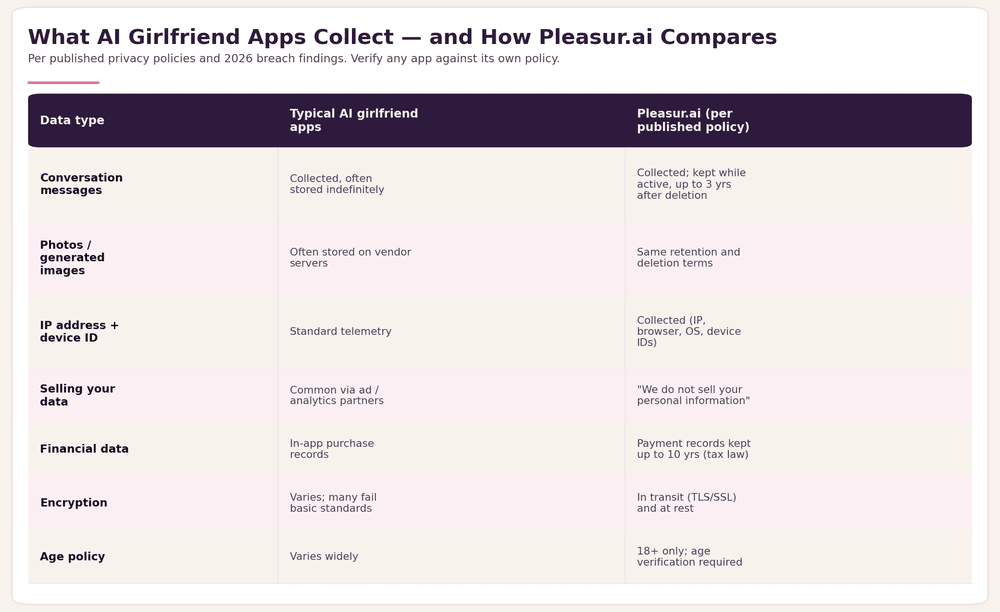
Most AI companion apps gather four kinds of data: what you say, who you are, what device you use, and what you pay. The table below compares the typical pattern against what Pleasur.ai's published privacy policy commits to.
| Data type | Typical AI girlfriend apps | Pleasur.ai (per published policy) |
|---|---|---|
| Conversation messages | Collected and often stored indefinitely | Collected; kept while your account is active, then up to 3 years after deletion |
| Photos / generated images | Collected, often stored on vendor servers | Collected as generated content; same retention and deletion terms |
| IP address + device ID | Standard telemetry | Collected (IP, browser, OS, device identifiers) |
| Third-party data selling | Common via ad and analytics partners | "We do not sell your personal information"; no ad partners listed as recipients |
| Financial data | In-app purchase records | Payment records kept up to 10 years to meet tax and financial law |
| Encryption | Varies; many apps fail basic standards | In transit (TLS/SSL) and at rest |
| Age policy | Varies widely | 18+ only; states it does not knowingly collect data from minors |
Every Pleasur.ai entry above is drawn directly from its published privacy policy. The "typical app" column reflects documented industry patterns and the 2026 breach findings below.
The 2026 breaches: this is systemic, not edge-case
The risk is not hypothetical. A string of 2025–2026 incidents shows the same thing: the apps handling your most intimate conversations often ship with the weakest security.
A [150-million-install audit found over half were exposing chats](https://www.androidheadlines.com/2026/03/ai-girlfriend-apps-security-risk-2026-study.html). A 2026 study examined 17 AI companion apps on Google Play with more than 150 million combined installs. It reported 14 critical and 311 high-risk vulnerabilities. More than half exposed intimate chat histories through flaws like hardcoded credentials and script injection. One app with over 10 million downloads shipped cloud credentials — including an API token — directly in its public code.
MyLovely AI, April 2026: 113,000 explicit prompts exposed. A misconfigured database at the NSFW platform MyLovely AI leaked roughly 113,000 explicit prompts, with nearly 70,000 tied to unique user IDs. The leak also included email addresses, generated images, and linked social profiles. Because identifiable data and explicit content sat in the same records, the breach effectively de-anonymized users' sexual activity — a textbook setup for doxxing and sextortion.
Two companion apps, October 2025: 43 million messages. The same 2026 audit also documented an earlier incident: two major AI girlfriend apps that leaked more than 43 million intimate messages and hundreds of thousands of photos from over 400,000 users. The cause was basic misconfiguration, not a sophisticated attack.
This is not new. Back in 2024, a different AI companion site was breached and users' private fantasies were stolen wholesale. The pattern has held for years.
There is a regulatory gap under all of this. AI companion apps are not classified as healthcare or therapy products, so protections like HIPAA do not apply — even when the data is more sensitive than a medical record. Academic work backs the concern. A CHI 2026 study on privacy in human-AI romantic relationships found that AI companions actively encouraged personal disclosure, while users' privacy boundaries grew "more permeable" as emotional closeness increased. The dynamic the researchers describe means the most sensitive data is also the data these apps are best at drawing out.
How to vet an AI companion app before you trust it
Before you type anything private into a companion app, run it through this checklist. If an app fails most of these, treat it as a data risk.
- Does the privacy policy name specific third-party recipients? Vague "we may share with partners" language is a red flag. You want named categories and a clear statement on whether your data is sold.
- Is there a real deletion process? You should be able to delete your account and request erasure at any time — not email support and hope.
- Is your data encrypted in transit *and* at rest? Many breached apps encrypted neither. Both should be stated plainly.
- Is the company subject to GDPR or CCPA? A policy that names these frameworks and lists your access, correction, and deletion rights is a stronger signal than one that stays silent.
- Is there real age verification before adult content? An adult platform should gate access at 18+ and say so.
How Pleasur.ai handles your data
Pleasur.ai is an 18+ platform, and its data practices are set out in a public privacy policy. The points below are self-reported commitments, not an independent audit — so run them through the same checklist above, and read the policy yourself. Here is what it states, point by point.
What it collects, and why. Per the published policy: account details you provide, such as email, username, and profile preferences. Technical data needed to run the service: IP address, browser, operating system, device identifiers. And the content of your chats and generated images. That is the data required to deliver and secure the product.
What it does not do. The policy states it plainly: "We do not sell your personal information." It does not list third-party advertising partners among its recipients — the kind of sharing that drives most companion-app privacy complaints. Data shared with service providers, such as hosting, payment processing, analytics, and AI model infrastructure, is governed by service agreements, not open-market sale.
Retention and deletion. Your account data is kept while your account is active and for up to three years after deletion. Payment records are held up to ten years, because tax and financial regulations require it. You can request deletion of your personal data at any time — by contacting Pleasur.ai or by deleting your account directly.
Encryption. Your data is encrypted both in transit (TLS/SSL) and at rest. That is the standard many breached apps failed to meet.
Age and compliance. Pleasur.ai is intended only for adults 18 and over. It gates access through age verification and states it does not knowingly collect data from minors. The policy references GDPR, UK GDPR, and CCPA, and sets out your rights to access, correct, delete, and port your data.
You can read the full text in the Pleasur.ai privacy policy and the terms of service, or see the security and data commitments gathered in the trust center. If you want to start with a companion built around your preferences, you can create one here.
Frequently asked questions
What data do AI girlfriend apps collect? Most AI girlfriend apps collect your conversation messages, photos, IP address, device identifiers, and financial transaction data. A 2026 audit of top apps found that more than half had critical flaws exposing intimate chat histories to unauthorized access.
Are AI companion apps safe to use in 2026? Safety varies sharply by platform. Look for encryption in transit and at rest, a clear no-sale data policy, and a working deletion process. Be cautious with apps named in the 2025–2026 breach reports, several of which exposed user data through basic misconfiguration.
Which AI girlfriend app has the best privacy in 2026? There is no single "safest" app, and any app claiming to be is overselling. The better question is which practices an app actually commits to and lets you verify. The strongest signals are encryption in transit and at rest, a stated "we do not sell your data" policy, named data recipients, and a self-serve deletion right. Among platforms that publish all four, Pleasur.ai's privacy policy is one example you can read in full and check against this list.
Can AI girlfriend apps share your conversations with third parties? Many can and do. Privacy policies frequently permit sharing with analytics, advertising, and AI-training partners. Review each app's policy for an explicit statement on selling versus sharing, and check for opt-out rights under GDPR or CCPA.
What data does Replika collect? According to its privacy policy and an independent Mozilla *Privacy Not Included* review, Replika collects your chat history, photos, voice recordings, device information, location, and usage analytics. Mozilla reported that the app loaded large numbers of third-party trackers and shared behavioral data with advertising and marketing partners. Users concerned about ad-partner sharing often look for alternatives.
Is Pleasur.ai safe to use? Pleasur.ai is built for adults 18 and over, and its published privacy policy commits to encryption in transit and at rest, a no-sale data policy, retention limits, and deletion on request. No platform can guarantee perfect security. But those are the concrete practices to weigh — and they are the same ones this guide tells you to check on any companion app.